History of Cuba
If you don't want to hear the music, Click below
In 1868, the Ten Years' War broke out. In many ways, the Ten Years' War was similar to the American War of Independence.
Spain mercilessly exploited Cuba's people and resources. The war broke out after Spain completely refused Cuban demands not dissimilar to those made by the Thirteen Colonies. Not only did she refuse the Cubans' demands, Spain began to increase her military presence in Cuba.
The Ten Years' War started on October 10, 1868, when 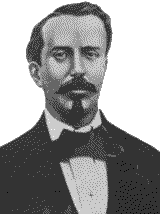 Carlos Manuel de Céspedes freed his slaves from their labor in his sugar plantation. Céspedes did not act alone; many other slave-owners freed their slaves to fight for independence as well.
The rebels were led by 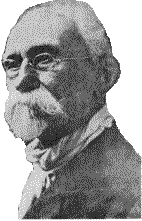 Máximo Gómez, who was joined by
 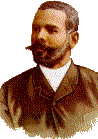 Antonio Maceo.
The Spanish brought in troops and also drew its forces from people living in Cuba who sided with them, similar to the loyalist forces who sympathized with the British during America's War of Independence.
The Ten Years' War was without major battles. It was primarily a guerilla war. The Cubans used hit-and-run tactics and attempted to destroy everything they could.
The war was ended by Arsenio Martínez de Campos, a Spanish general. His promises of reforms (many of which the Spanish did not intend to keep) convinced the Cubans under Gómez and Maceo to end their rebellion.
 History of Cuba |
 Cuban Flag and Emblem |
 Independence War |
 José Martí |
 Antonio Maceo |
 Maximo Gomez |
 Calixto García Iñiguez |
 Carlos Manuel de Céspedes |
 Pagina Principal / Home |
 Top
Top
 juan@juanperez.com
Last time this page was edited August 18, 2015
@copyright 2015 Perez Professional Services all rights reserved
This page was created by Perez Professional Services (561) 313-6041