History of Cuba
If you don't want to hear the music, Click below
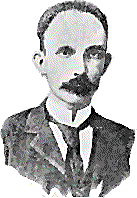
José Martí was born in Havana in 1853. At seventeen he was exiled to Spain for his opposition to colonial rule. There he published a pamphlet exposing the horrors of political imprisonment in Cuba, which he himself had experienced. Upon graduating from the University of Saragossa, he established himself in Mexico City, where he began his literary career. His objection to a regime installed by a military coup led him to depart for Guatemala, but government abuses forced him to abandon that country as well. In 1878 he returned to Cuba under a general amnesty, but he conspired against the Spanish authorities and again was banished. He fled exile in Spain and came to the United States. After a year in New York he left for Venezuela, where he hoped to settle, but yet another dictatorship forced him to depart. Martí went back to New York where he lived from 1881 to 1895. In that year, he left to join the war for Cuban independence which he had so painstakingly organized. There he died in one of its first skirmishes.
José Martí is considered one of the great writers of the Hispanic world. His significance for the American Reader, however, stems from the universality and timelessness of his thought. Martí devoted his life to ending colonial rule in Cuba and to preventing the island from falling under the control of any country (including the United States) whose political ideologies were inimical to the principles he held. With those goals, and with the conviction that the freedom of the Caribbean was crucial to Latin American security and to the balance of power in the world, he devoted his talents to the forging of a nation. Thus, the scope of his work: he was a revolutionary, a guide, and more importantly, a mentor. His vast experience and education enabled him to move comfortably in the most diverse fields, which is what makes his teachings so rich to us indeed.
Insofar as Martí believed that freedom and justice should be the cornerstones of any government, one has only to read his work and learn of the struggle that he took up freely. He could never accept the curtailment of the natural expansiveness of the human spirit, for truly he believed that man's redemption would come through love and unfettered reason. Therefore, his doctrines are, and must be, at odds with the totalitarian dogma that has existed in Cuba since its unfortunate demise.
All of Martí's teachings contradict that political system which never fails to demonstrate its intolerance towards individual freedom and it's love of its own materialistic empowerment. His writings condemn all despotic regimes and the abridgment of human rights. Furthermore, he goes on to denounce the lack of spirituality and type of arrogance that we find in the current dictatorship. For this reason, the publication of Martí's thoughts, in all its force, is of the greatest importance today. His beliefs, which can guide democracies and if heeded, offer them greater security, speak more eloquently against the Cuban apostasy than all the accusations that others might make.
 Antonio Maceo |
 Maximo Gomez |
 Calixto García Iñiguez |
 Carlos Manuel de Céspedes |
 History of Cuba |
 Cuban Flag and Emblem |
 The Ten Years' War |
 Independence War |
 Pagina Principal / Home |
 Top
Top
 juan@juanperez.com
Last time this page was edited August 18, 2015
@copyright 2015 Perez Professional Services all rights reserved
This page was created by Perez Professional Services (561) 313-6041