History of Cuba
If you don't want to hear the music, Click below
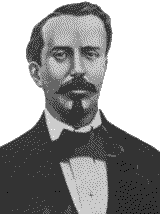
Born on April 18, 1819, Carlos Manuel de Céspedes is considered by many Cubans to be the "Father of the Nation".
Céspedes, who owned a plantation in eastern Cuba, began the 10 Years' War when he freed his slaves and asked others to join his armed resistance against Spain. He wanted independence for Cuba, which he announced through the Grito de Yara (Cry of Yara).
Guerilla warfare was practiced by the Cuban troops, whose numbers soon grew. Céspedes became the general in chief. His forces captured the city of Bayamo and made it their capital.
When Spanish troops were sent to take the city, the outnumbered Cuban troops left and burnt it to the ground. Céspedes' birthplace was one of a few buildings that did not burn.
As the war went on, Céspedes' major goal was to attain American recognition of the new Cuban government, though it was to be an unrealized goal. Céspedes ran a constitutional convention, which decided upon a representative government for Cuba and proposed the abolition of slavery.
Céspedes was deposed by other revolutionaries in 1873. A year later, he was apprehended by the Spanish and executed.
Eventually Spain reached a settlement with the revolutionaries, but broke many of its promises.
Céspedes also published Cuba's first independent newspaper, the Cubano Libre (The Free Cuban).
 José Martí |
 Antonio Maceo |
 Maximo Gomez |
 Calixto García Iñiguez |
 History of Cuba |
 Cuban Flag and Emblem |
 The Ten Years' War |
 Independence War |
 Pagina Principal / Home |
 Top
Top
 juan@juanperez.com
Last time this page was edited August 18, 2015
@copyright 2015 Perez Professional Services all rights reserved
This page was created by Perez Professional Services (561) 313-6041